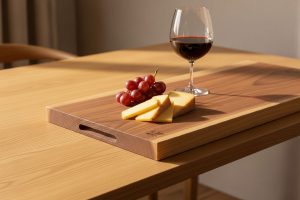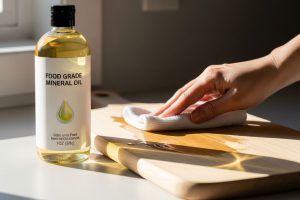
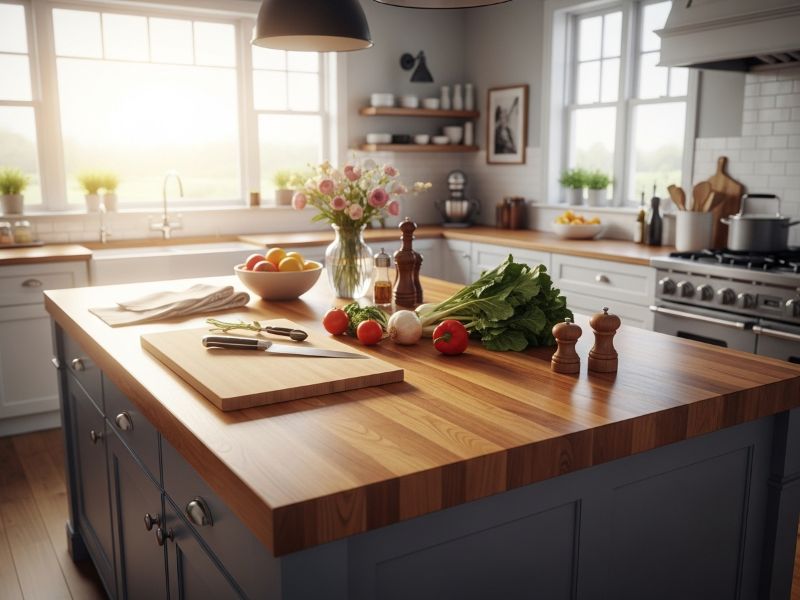
Choosing the right wood for a butcher block countertop transforms your kitchen from a sterile workspace into the warm, inviting heart of your home. Unlike cold stone or steel surfaces, wood brings natural beauty, character, and practicality that resonates with both professional chefs and home cooks. But here’s what many homeowners don’t realize: not all woods perform equally in the demanding kitchen environment. Whether you’re drawn to maple’s classic durability, walnut’s premium elegance, or oak’s balanced affordability, selecting the proper wood determines how your countertop will look, perform, and age over the next decade.
Best Wood for Butcher Block
Hard Maple (The Classic Standard)
Hard maple has earned its reputation as the best hardwood for butcher block through generations of professional and home use. With a Janka hardness rating of approximately 1,450, this workhorse wood strikes the perfect balance between durability and workability.
Pros
- Exceptionally stable with minimal warping or movement: Maple holds its shape well and is less prone to expansion or contraction in changing kitchen conditions.
- Fine, closed grain structure resists bacteria and staining: The tight grain leaves fewer pores, making the surface naturally more hygienic and easier to clean.
- Light, neutral color complements any kitchen palette: Its pale tone blends effortlessly with modern, rustic, or traditional kitchen styles.
- Widely available at reasonable prices: As one of the most common North American hardwoods, maple is easy to source and cost-effective.
- Takes finishes uniformly without blotching: Oils and sealants absorb evenly, resulting in smooth, consistent finishes.
Cons
- Requires regular oiling to maintain water resistance: Without conditioning, the surface can dry out and absorb moisture more easily.
- Light color shows stains more readily than darker woods: Spills or food marks are more noticeable on its pale surface.
- Can develop a yellowish tinge over time without proper care: Prolonged exposure to sunlight or heat can slightly shift its color.
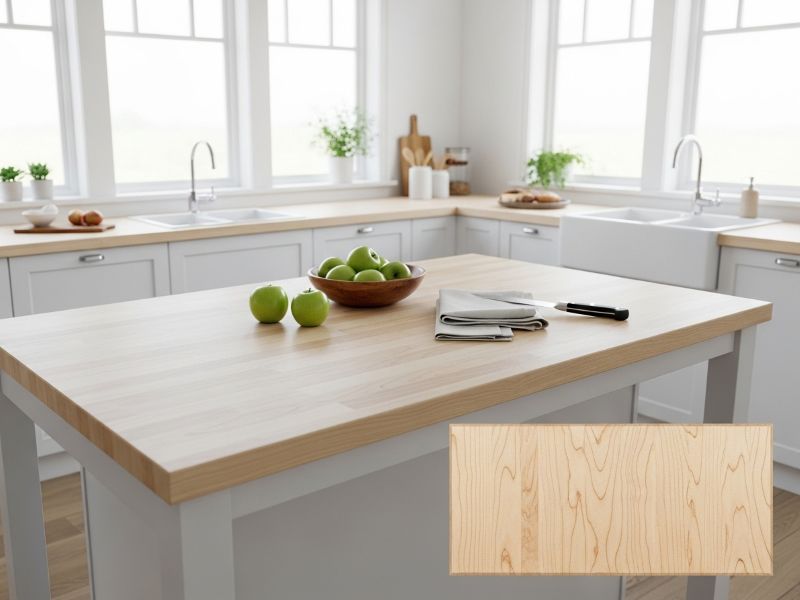
Maple’s tight grain pattern creates a smooth, hygienic surface that’s easy to clean and maintain. Professional butchers have trusted maple for centuries because it’s gentle on knife edges while providing sufficient hardness to resist deep cuts and gouges. For homeowners seeking reliability without breaking the budget, maple remains the gold standard.
Walnut (Premium & Stylish)
Black walnut elevates any kitchen with its rich chocolate tones and sophisticated grain patterns. As one of the best wood for butcher block countertops for design-conscious homeowners, walnut offers unmatched visual appeal that deepens and mellows beautifully with age.
Pros
- Stunning dark color creates an instant visual impact: Walnut’s rich brown tones add a premium look and make the countertop a true centerpiece in any kitchen.
- Natural oils provide some water resistance: The wood contains natural compounds that help slow down moisture absorption compared to lighter hardwoods.
- Develops gorgeous patina over time: With age and use, walnut deepens in color and gains a warm sheen that enhances its character.
- Excellent dimensional stability: Walnut resists warping and movement, making it reliable for long-term use in kitchens.
- Works well in both traditional and contemporary settings: Its versatile aesthetic suits everything from modern industrial designs to rustic farmhouse spaces.
Cons
- Softer than maple (Janka rating ~1,010), more prone to denting: Walnut is durable but not as hard as maple, so heavy impacts or chopping can leave marks.
- Premium pricing reflects limited availability: As a sought-after hardwood with less supply, walnut typically comes at a higher cost.
- Dark color can hide dirt but also shows scratches more readily: Everyday dust or crumbs are less noticeable, but light-colored scratches can stand out against the dark surface.
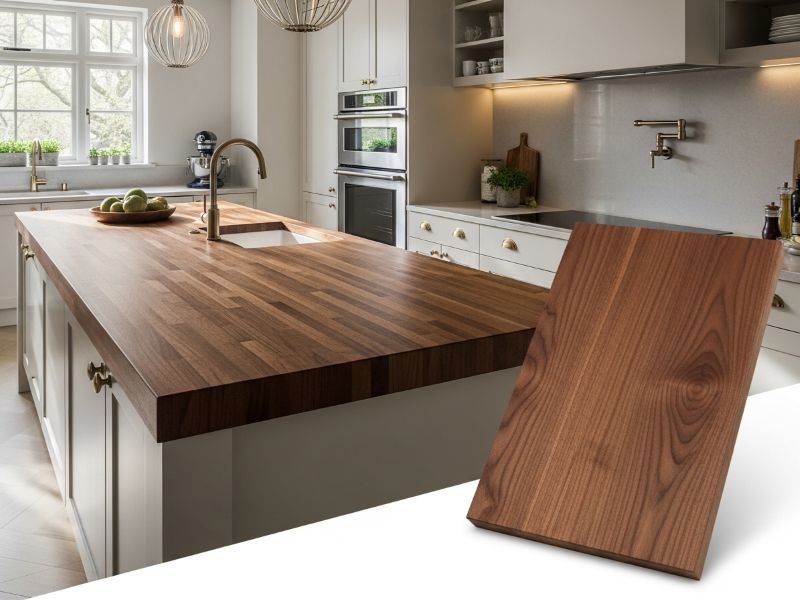
Walnut’s natural elegance justifies its higher cost for many homeowners. The wood’s inherent oils make it somewhat self-sealing, though regular maintenance remains essential. If you’re using walnut primarily as a prep surface rather than a cutting board, its slightly softer nature becomes less concerning while its aesthetic benefits shine.
Cherry (Warm & Elegant)
Cherry wood brings unparalleled warmth to kitchen spaces, starting with peachy-pink tones that mature into rich reddish-brown hues. This transformation makes cherry one of the most dynamic choices for best wood for butcher block counter applications.
Pros
- Beautiful color evolution adds character over time: Cherry starts with a warm reddish-brown tone that deepens with age, creating a unique patina full of character.
- Smooth, fine grain creates elegant appearance: Its refined texture gives countertops a polished, upscale look that works well as a statement feature.
- Moderately priced between maple and walnut: Cherry offers a balance of beauty and cost, sitting in the mid-range of hardwood pricing.
- Takes stain and finishes exceptionally well: The wood absorbs oils and finishes evenly, resulting in a rich, smooth surface when properly treated.
- Perfect for traditional and transitional kitchen styles: Its warm tones complement both classic farmhouse designs and more modern transitional spaces.
Cons
- Relatively soft (Janka ~995), susceptible to dents and scratches: Cherry is softer than maple or oak, so it can show wear from heavy kitchen use.
- Can develop uneven coloring if exposed to partial sunlight: Direct light may cause parts of the countertop to darken faster than others.
- Requires careful finishing to prevent blotchiness: If not sealed correctly, stains can absorb unevenly, leading to patchy or streaky results.
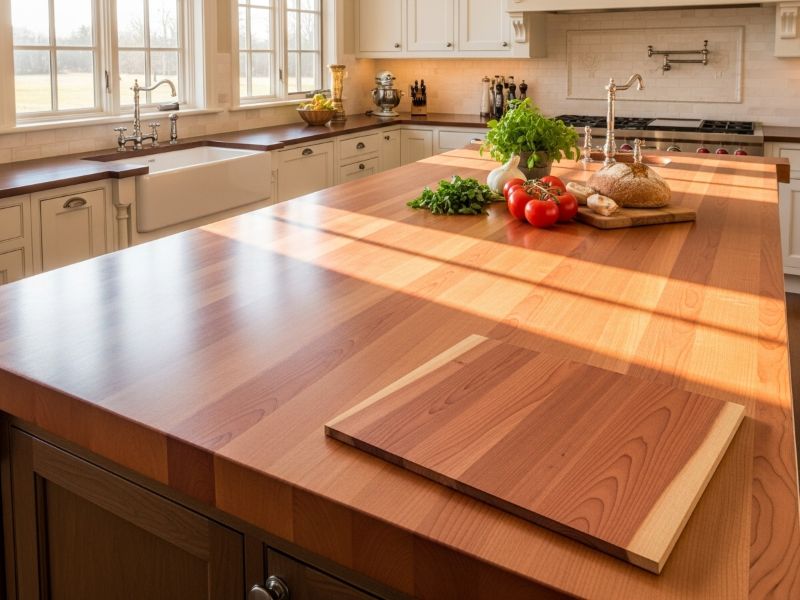
Cherry’s photosensitive nature means it will darken naturally over the first year of use, eventually stabilizing into its mature color. This characteristic delights homeowners who appreciate living materials that evolve, though it requires understanding that your countertop’s appearance will change significantly from installation day.
Oak (Durable & Affordable)
Oak, particularly white oak, offers exceptional value as wood for butcher block applications. Its widespread availability and moderate pricing make it accessible to budget-conscious renovators without sacrificing quality or durability.
Pros
- White oak’s tyloses provide natural water resistance: The pores are blocked with tyloses, making the wood less permeable and more suitable for areas exposed to moisture.
- Hard and durable (Janka ~1,360): Strong enough to withstand everyday kitchen use, offering long-lasting performance without excessive wear.
- Distinctive grain adds visual interest: The bold cathedral and ray fleck patterns create character and depth in countertop designs.
- Readily available and affordably priced: Oak is one of the most common hardwoods, ensuring consistent supply and cost-effectiveness.
- Excellent structural stability: Its density and strength make oak resistant to warping and dependable for large surface installations.
Cons
- Red oak’s open grain can harbor bacteria and stains: Without sealing, its porous structure may trap liquids and food particles.
- High tannin content may react with metal, creating dark spots: Contact with iron or steel can leave discoloration if the surface isn’t protected.
- Prominent grain patterns may not suit minimalist designs: While visually striking, the strong grain can feel too busy in sleek, modern kitchens.
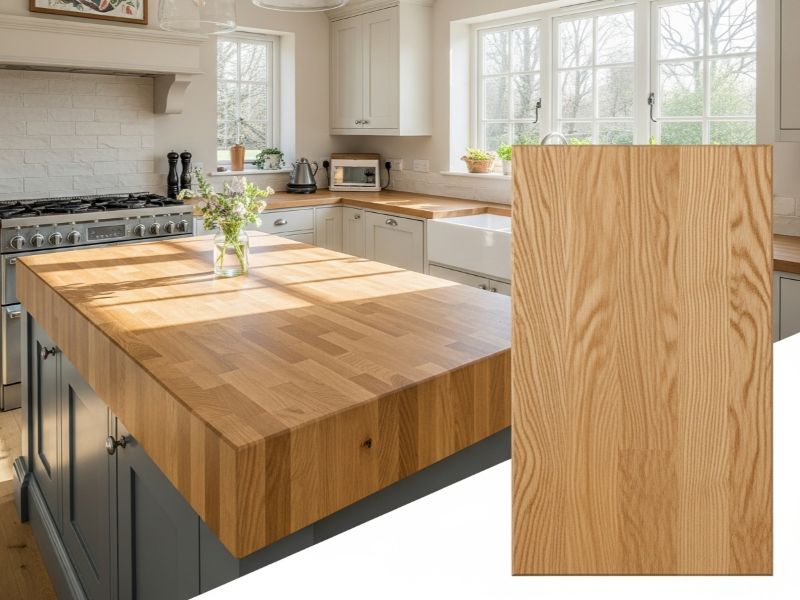
White oak’s natural water resistance makes it particularly suitable for areas near sinks or dishwashers. The wood’s pronounced cathedral grain patterns create visual drama, though some find this assertive appearance overwhelming in smaller kitchens. When properly sealed, oak provides decades of reliable service.
Hickory (Very Hard, Rustic Appeal)
Hickory brings unmatched hardness and distinctive character to butcher block countertops. With a Janka rating of approximately 1,880, it’s one of the hardest domestic woods available, making it ideal for heavy-use kitchens.
Pros
- Extreme hardness resists dents and damage: With a Janka rating around 1,880, hickory is one of the hardest domestic hardwoods, standing up to heavy daily use.
- Dramatic grain variation creates rustic appeal: Its bold light-and-dark contrasts make every countertop unique, ideal for farmhouse or rustic kitchens.
- Excellent shock absorption: The dense fibers absorb impact well, making hickory less likely to chip or crack under stress.
- Takes abuse better than most other woods: It can endure chopping, pounding, and everyday wear without showing significant damage.
- Natural resistance to decay: Hickory’s dense structure provides added durability against long-term deterioration.
Cons
- Difficult to work with due to extreme hardness: Its density makes cutting, sanding, and finishing more challenging during fabrication.
- Heavy weight complicates installation: Large hickory countertops require extra support and professional handling.
- High contrast grain may be too bold for some tastes: The rustic look can feel overpowering in modern or minimalist designs.
- Prone to seasonal movement without proper acclimation: Hickory expands and contracts more than many woods, requiring careful moisture control.
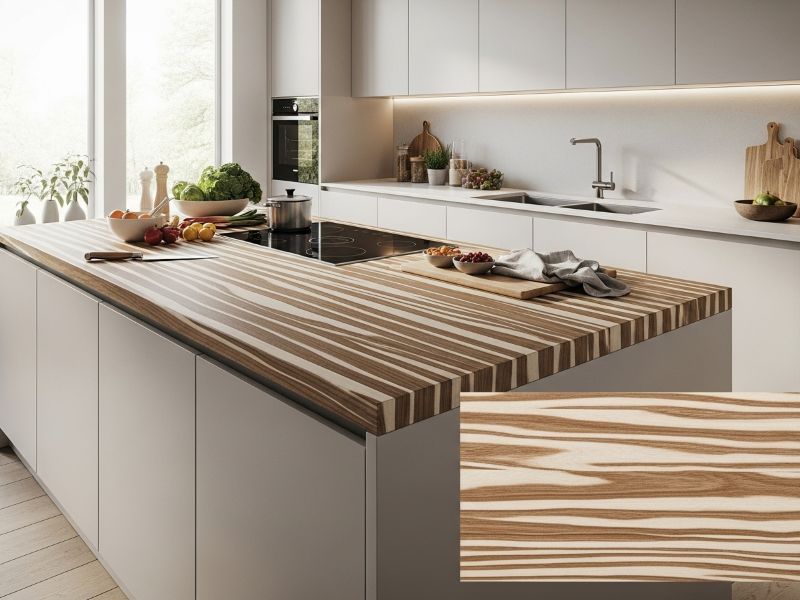
Hickory’s pronounced grain patterns, ranging from creamy white to dark brown, create a bold statement that defines a kitchen’s character. While its hardness makes it challenging to work with initially, the resulting countertop withstands decades of heavy use with minimal wear.
Bamboo (Eco-Friendly Alternative)
Though technically a grass, bamboo has emerged as a popular alternative for environmentally conscious homeowners seeking what is the best wood for butcher block countertops with minimal environmental impact.
Pros
- Rapidly renewable resource (harvest in 3–5 years): Bamboo grows much faster than hardwoods, making it one of the most eco-friendly options for butcher block surfaces.
- Strand-woven varieties are extremely hard and durable: These engineered versions are denser than many traditional woods, offering excellent strength and long service life.
- Unique linear grain pattern: Its modern, streamlined look adds a contemporary edge to kitchen designs.
- Naturally antimicrobial properties: Bamboo contains natural agents that help resist bacteria, making it a hygienic choice.
- Often more affordable than premium hardwoods: Typically priced lower than walnut or cherry, bamboo delivers a balance of performance and value.
Cons
- Quality varies significantly between manufacturers: Inconsistent processing can affect durability and safety, so certification is important.
- Adhesives used in production may be off-gas: Some bamboo products use glues with formaldehyde or VOCs, requiring careful sourcing of low-emission options.
- Carbonized versions are significantly softer than natural: Heat-treated bamboo offers a darker tone but loses hardness and durability.
- Less traditional warmth than genuine hardwood: While stylish, bamboo lacks the rich character and patina that solid hardwoods develop over time.
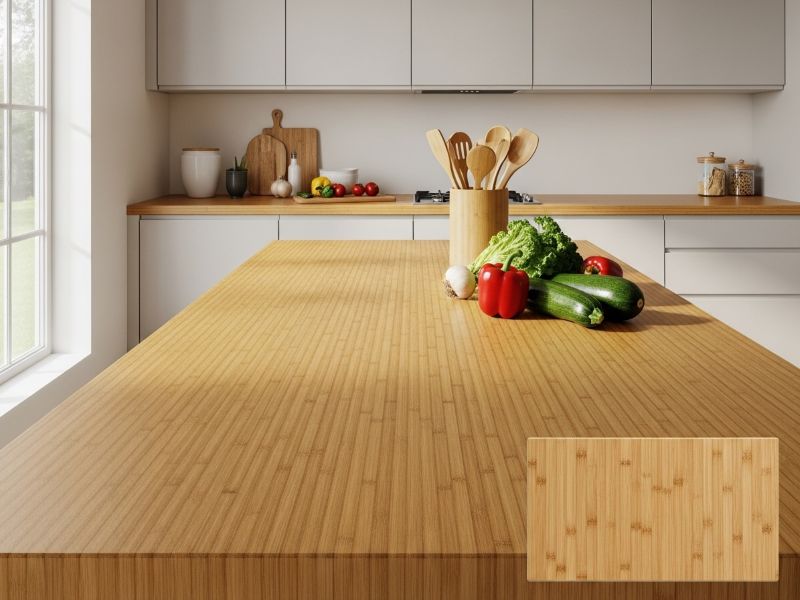
Bamboo’s sustainability credentials appeal to eco-conscious homeowners, while its modern appearance suits contemporary kitchen designs. Choose strand-woven bamboo for maximum durability, avoiding carbonized versions that sacrifice hardness for darker color.
Other Woods (Teak, Acacia, Birch)
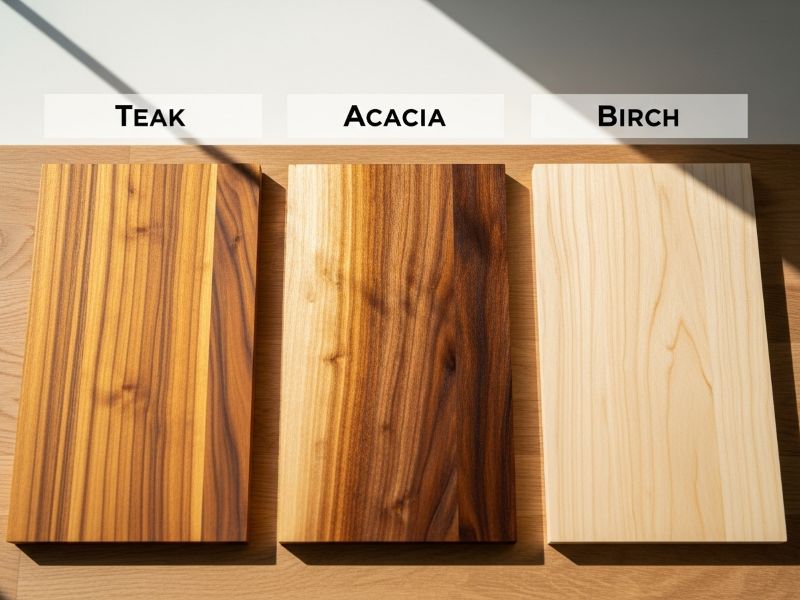
Teak stands out for its exceptional water resistance and natural oils that provide built-in protection against moisture and bacteria. Its high silica content can dull knives quickly, but for countertop applications where cutting boards are used separately, teak offers unmatched durability and exotic beauty. The premium price reflects both scarcity and superior performance in wet environments.
Acacia provides dramatic grain patterns and excellent hardness at moderate prices. Its varied coloration, from light amber to deep chocolate, creates visual interest though consistency between boards can vary. Acacia’s natural durability and water resistance make it suitable for kitchen use, though sourcing quality material requires careful supplier selection.
Birch offers an economical entry point for butcher block countertops. Its fine, uniform grain and light color resemble maple at a fraction of the cost. However, birch’s moderate hardness (Janka ~1,260) and average moisture resistance mean it requires more diligent maintenance than premium options. For budget-conscious homeowners willing to invest time in upkeep, birch provides acceptable performance.
Grain Construction Types
The grain construction of your butcher block significantly impacts both performance and price. Understanding these differences helps you choose the right balance of durability, aesthetics, and value for your specific needs.
End Grain (Durability & Knife-Friendly)
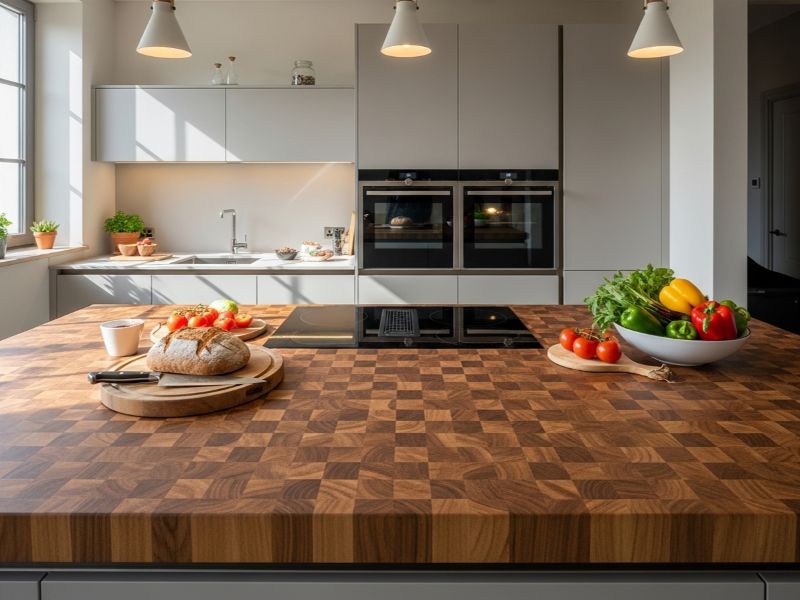
End grain butcher blocks are constructed with wood fibers oriented vertically, exposing the cut ends of the boards. This arrangement creates the classic checkerboard look seen in professional kitchens.
The biggest advantage of end grain lies in its self-healing surface: knife edges sink between fibers instead of severing them, so cuts are less visible, blades stay sharper, and the wood naturally closes up over time. This makes it the most forgiving option for anyone who actually chops directly on the countertop.
However, end grain surfaces are very porous and absorbent, meaning they soak up oils and finishes quickly. To prevent drying, cracking, or staining, they require regular oiling and conditioning – often more frequently than edge or face grain boards. Skipping maintenance can cause fibers to fuzz or the surface to dull.
Structurally, end grain is highly stable and resistant to warping under heavy use, but the complex assembly process makes it the most expensive grain construction. For this reason, many homeowners use end grain selectively, such as on kitchen islands or designated prep zones, where its premium performance and striking checkerboard pattern deliver both function and visual impact.
Edge Grain (Balanced & Affordable)
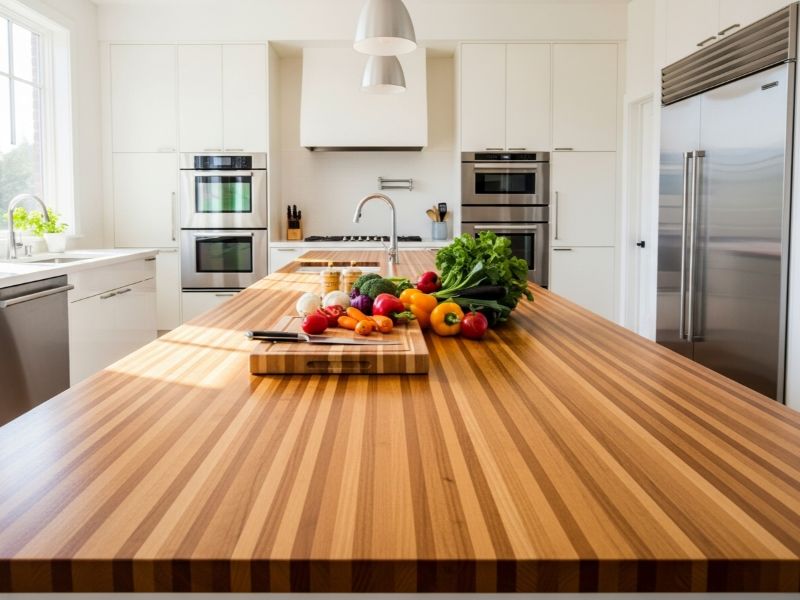
Edge grain butcher blocks are made by placing boards on their sides so the long edges form the working surface. This results in a countertop with straight, parallel lines that showcase the natural flow of the wood grain.
As the most popular construction for residential kitchens, edge grain strikes a balance between durability, cost, and aesthetics. It provides solid structural stability and withstands daily prep tasks, making it suitable for light to moderate cutting. Unlike end grain, it does not self-heal, so knife marks accumulate more easily, but with regular sanding and oiling the surface can be refreshed.
From a maintenance perspective, edge grain is less absorbent than end grain, so it requires oiling less frequently, yet still benefits from consistent conditioning to protect against moisture and stains. It holds up well under typical kitchen humidity but should not be left unsealed near sinks or dishwashers.
Edge grain also offers strong value for money, costing about 30-40% less than end grain while delivering a clean, modern look. It is widely used for full countertops, work islands, or prep zones where homeowners want a balance of beauty, practicality, and affordability without the premium cost of end grain.
Face Grain (Less Durable, Budget Option)
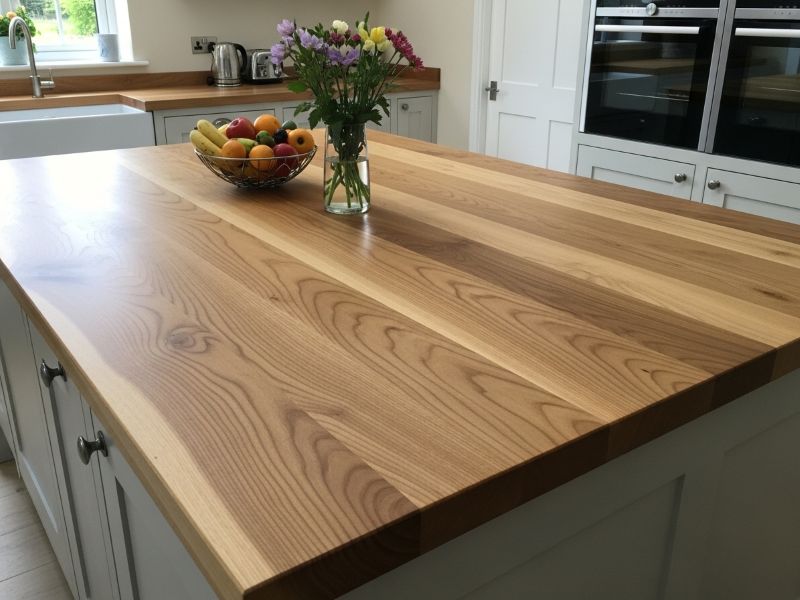
Face grain butcher blocks are made by laying boards flat so the broad surface of each plank forms the countertop. This method highlights the wood’s natural character more vividly than any other construction, showcasing cathedral arches, swirls, and figure patterns in dramatic detail. Because it uses the least labor and material, face grain is the most affordable grain option.
The trade-off is durability. Face grain is the least resistant to wear and tear: the wide surface of the fibers is more prone to cupping, splitting, and showing knife marks. Seasonal expansion and contraction can also create visible seams between boards if the countertop isn’t properly sealed and acclimated. While stunning to look at, it requires careful maintenance and should never be relied on for heavy food prep.
From a maintenance standpoint, face grain surfaces are highly absorbent and need frequent oiling or sealing to prevent moisture damage and staining. Even with regular care, they will develop scratches and marks quickly if used for direct cutting.
Because of these limitations, face grain butcher blocks are best suited for decorative islands, bar tops, or accent surfaces where visual impact takes priority over long-term durability. For homeowners seeking the look of real wood without the premium cost, face grain offers a budget-friendly way to bring warmth and character into the kitchen.
How a Butcher Block Transforms Your Kitchen
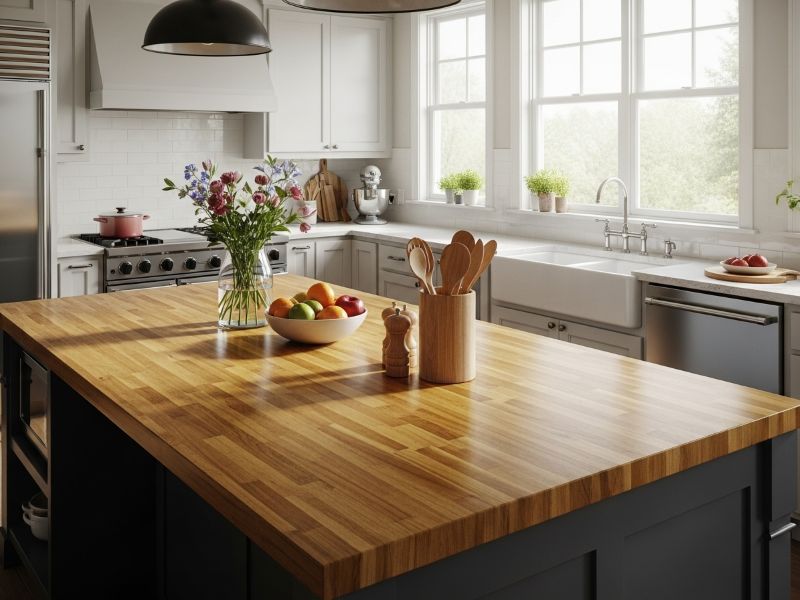
A butcher block countertop does more than provide a work surface – it transforms your kitchen’s atmosphere and functionality. The natural warmth of wood creates an inviting environment that stone or quartz cannot match, turning the kitchen into a true gathering place.
Wood for butcher block offers both design flexibility and hands-on practicality. Maple fits minimalist kitchens, walnut adds a bold statement, and cherry warms up farmhouse spaces. Beyond looks, butcher block appeals to DIY enthusiasts: scratches can be sanded out at home, oiling is quick and simple, and the surface can be refinished repeatedly. This renewability means your countertop not only lasts for decades but also evolves with your kitchen, developing a patina that tells your family’s story.
How to Choose the Right Wood for Your Butcher Block
Budget and availability come first. Maple and oak are the go-to choices for value, offering strength and beauty at a moderate price. If your priority is a premium, high-end look, walnut and cherry stand out with their rich colors, though they cost significantly more. Eco-conscious homeowners may prefer bamboo, which combines sustainability with a modern aesthetic. Whenever possible, locally sourced woods reduce cost, environmental impact, and shipping-related instability.
Durability and intended use should guide your selection. Heavy-use kitchens benefit from harder species like maple or hickory, which resist dents and wear. Lighter-use kitchens, where appearance matters more, can rely on cherry, walnut, or oak. For high-moisture zones – such as near sinks or dishwashers – white oak or teak are excellent choices because of their natural resistance to water.
Maintenance commitment is another factor. All butcher blocks need oiling and sealing, but some woods demand more frequent care. End-grain maple or hickory absorb oil quickly and require conditioning often, while walnut and teak’s natural oils extend the time between treatments. For homeowners who want minimal upkeep, factory-finished bamboo or sealed edge-grain tops provide easier maintenance.
Aesthetics and kitchen style matter as much as performance. Maple’s pale, clean look suits modern and Scandinavian designs. Walnut adds drama and luxury to transitional or contemporary kitchens. Cherry deepens into a warm patina that highlights farmhouse and rustic interiors, while oak’s bold grain pattern provides character at a more affordable price. Bamboo brings a sleek, linear style that fits modern, eco-forward spaces. Keep in mind how light affects each species: cherry darkens, walnut lightens, maple stays neutral.
Grain construction determines functionality. End grain is the premium choice if you plan to cut directly on the surface – it’s knife-friendly and self-healing. Edge grain offers the best balance for most households, durable enough for prep while keeping costs reasonable. Face grain emphasizes dramatic wood patterns at the lowest cost but works best in decorative settings rather than high-use areas.
Final Thoughts
Butcher block countertops bring incomparable warmth and character to kitchens, creating inviting spaces where cooking becomes a pleasure rather than a chore. Each wood species – from workhorse maple to elegant walnut – offers distinct advantages that appeal to different homeowners’ priorities and preferences.
The journey to finding your perfect butcher block begins with honest assessment of your needs, budget, and design goals. Consider how you actually use your kitchen, not just how you imagine using it. Factor in your willingness to maintain wood surfaces and your tolerance for the patina that develops through use.
Remember that the best wood for a butcher block isn’t necessarily the hardest or most expensive option – it’s the one that aligns with your lifestyle, aesthetic preferences, and practical requirements. Whether you choose classic maple for its proven reliability, splurge on walnut for its undeniable beauty, or select eco-friendly bamboo for its sustainability, your butcher block countertop will reward proper selection and care with decades of faithful service and timeless appeal.