The standard cutting board size represents the typical dimensions most kitchens find practical after years of ergonomic testing. Choosing the right size improves cooking efficiency, knife safety, and workspace organization. This guide provides size charts, and tips for matching board dimensions to your cooking style and space.
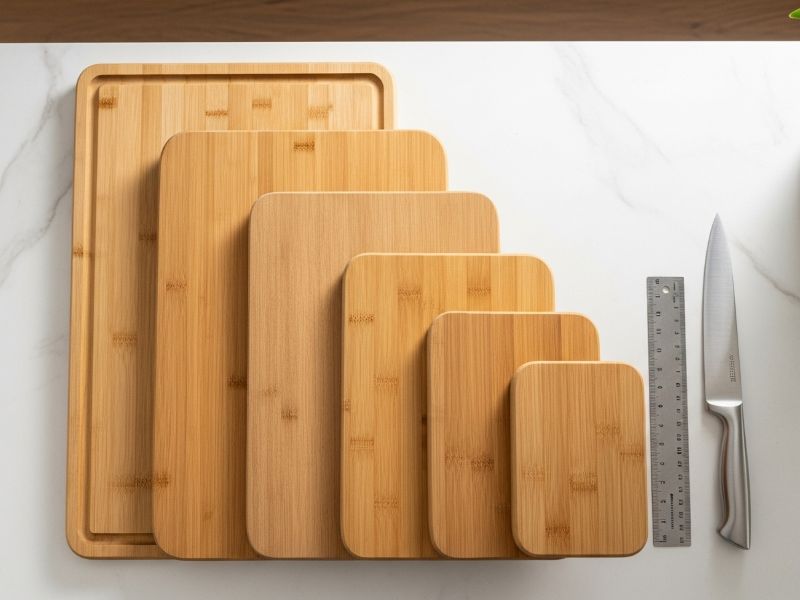
Why Cutting Board Size and Thickness Matter
Choosing the right cutting board size and thickness impacts your cooking efficiency, safety, and how long the board lasts.
A board that’s too small causes ingredients to spill and knives to slip, while an oversized one can crowd your counter and feel awkward to clean or store.
Standard sizes like 8″×10″, 12″×18″, and 18″×24″ have been refined over decades of home and commercial kitchen use. Custom boards serve special setups – such as kitchen islands or butcher blocks – but aren’t mass-produced.
Thickness determines stability and durability:
- Thin boards (<¾″) flex easily, dull knives faster, and warp within months.
- Thicker boards (1.5″+) stay stable, resist warping, and last years longer, though they’re heavier to move.
Simply put, thickness isn’t luxury – it’s structure. Understanding both size and thickness helps you choose a board that truly fits your space, habits, and cooking style.
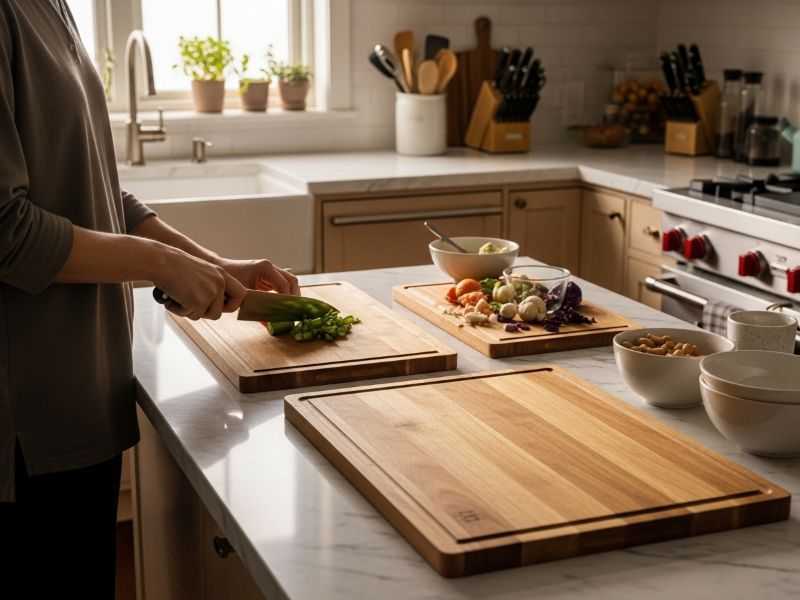
Common Sizes of Cutting Boards
Cutting boards come in four main sizes, each suited to specific tasks and kitchen layouts, refined through years of professional use and production data
Small Cutting Board
Small boards measure 8″ × 10″ or 10″ × 12″, with thickness typically between 0.5 and 0.75 inches. These compact dimensions serve specific purposes where full-size boards create unnecessary bulk.
Typical specifications:
- Surface area: 8″ × 10″ to 10″ × 12″
- Thickness range: 0.5″ – 0.75″
- Weight: 1–2 pounds depending on material
Small boards excel at quick tasks – slicing cheese for sandwiches, chopping herbs for a single dish, or cutting fruit for breakfast. Their size advantage becomes clear in apartments or kitchens with limited counter space, where a large board would dominate the entire work surface. Storage is straightforward; they fit in standard drawers or lean against backsplashes without requiring dedicated cabinet space.
The limitation is workspace: you cannot prep multiple ingredients simultaneously, and tasks like butterflying chicken breasts or slicing large vegetables become impractical. These boards work as secondary tools, not primary prep stations.

Medium Cutting Board
The 12″ × 18″ dimension represents the most common standard for home kitchens, with thickness ranging from 0.75 to 1 inch. This size emerged as the optimal balance point through testing across thousands of household cooking patterns.
Typical specifications:
- Surface area: 12″ × 18″
- Thickness range: 0.75″ – 1″
- Weight: 3–5 pounds depending on material
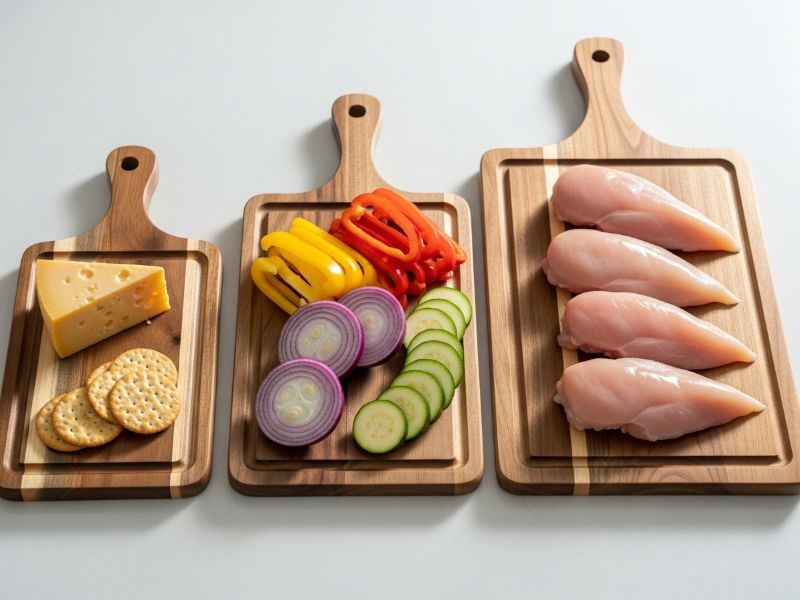
Medium boards handle the majority of home cooking tasks – prepping vegetables for dinner, slicing bread, portioning meat for four people. The surface area accommodates ingredient staging (raw chicken on one side, vegetables on another) while still fitting standard 24-30 inch counters with room for bowls and cutting tools nearby.
Storage requires either a dedicated cabinet slot or standing vertical storage, but the size remains manageable for most households. This dimension works for 70-80% of regular cooking needs based on meal preparation studies conducted across average American households.

Large Cutting Board
Large boards measure 18″ × 24″ with thickness from 1 to 1.5 inches. These dimensions serve users who regularly butcher meat, prepare meals for larger groups, or want substantial workspace for complex recipes.
Typical specifications:
- Surface area: 18″ × 24″
- Thickness range: 1″ – 1.5″
- Weight: 8–12 pounds depending on material
The additional surface area becomes necessary when working with whole chickens, large roasts, or multiple ingredients that need separation during prep. Butchering tasks require this size to contain liquids and provide stable support during heavy knife work. Holiday cooking – when you’re prepping ingredients for 8-10 people – makes the expanded workspace practical rather than excessive.
The tradeoff is weight and storage. These boards require dedicated cabinet space or permanent counter placement. Moving them during prep becomes a two-hand task, and washing means committing to a full sink cycle. Households that cook at this scale regularly find the inconvenience worthwhile; occasional cooks may find them impractical.
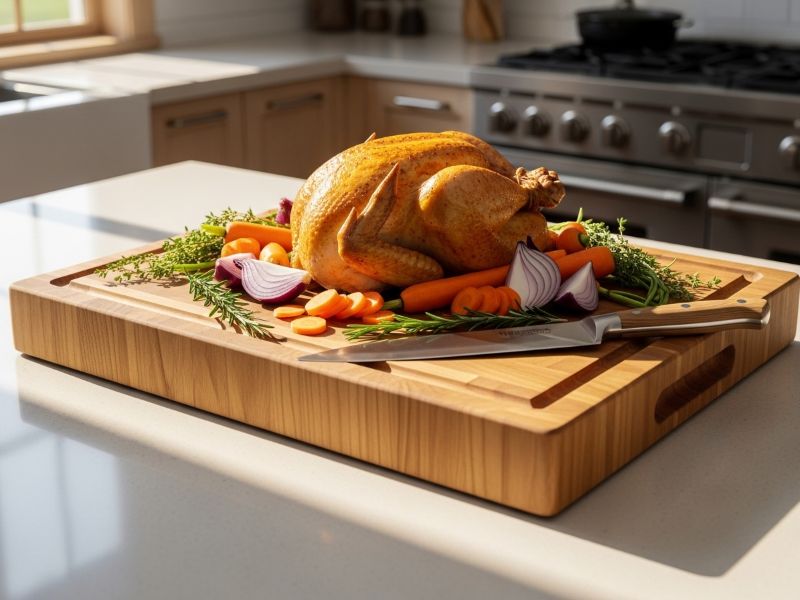
Extra-Large Cutting Board
Extra-large boards start at 24″ × 36″ and extend into custom butcher block territory, with thickness from 1.5 to 2.5 inches or more. These are professional-grade work surfaces designed for commercial kitchens or dedicated home cooking stations.
Typical specifications:
- Surface area: 24″ × 36″ and larger
- Thickness range: 1.5″ – 2.5″+
- Weight: 20–40+ pounds depending on construction
Extra-large boards serve professional kitchens where multiple cooks work simultaneously, or home users who’ve built dedicated prep stations into their kitchen islands. They function as permanent fixtures – the weight and size make moving them impractical for regular cleaning. Many users in this category employ these boards as serving stations for charcuterie displays, BBQ prep areas, or as primary butchering surfaces.
The stability is substantial; the mass prevents any movement during heavy chopping, and the thickness ensures decades of use without warping. However, these boards require professional maintenance – regular oiling cycles, specialized storage conditions, and in many cases, professional resurfacing every few years to maintain the cutting surface.
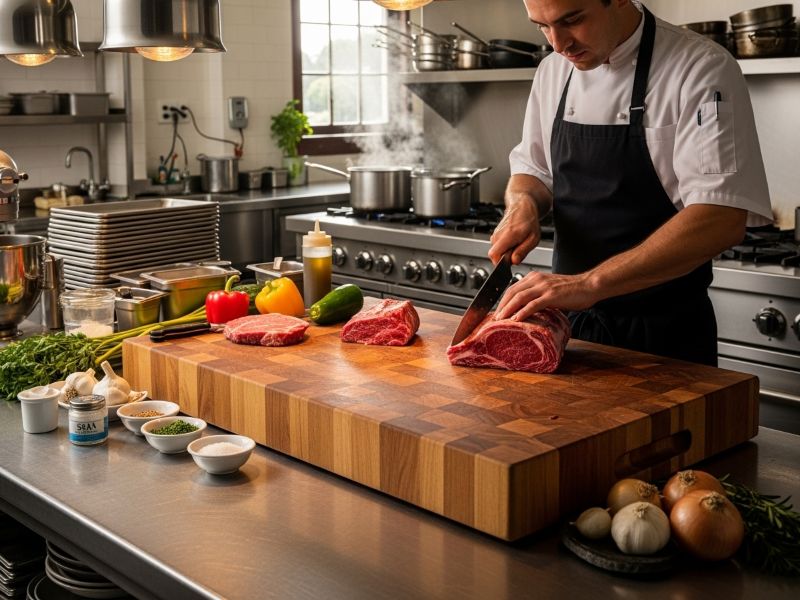
Thickness Considerations for Cutting Boards
Thickness determines how a cutting board responds to stress over time – specifically knife impact, moisture cycling, and the repeated expansion-contraction that occurs with washing and drying. Boards below 1 inch thickness show measurable warping within 12-24 months of regular use. Boards at 1.5 inches or thicker maintain dimensional stability for 5+ years under identical conditions. This isn’t preference; it’s physics.
Thickness categories and their performance characteristics:
| Thickness Range | Stability Rating | Weight Class | Best Application | Typical Lifespan |
|---|---|---|---|---|
| Under 1″ (0.5″–0.75″) | Low – moderate flex under pressure | Light (1–3 lbs) | Quick prep, temporary use, travel | 1–2 years with regular use |
| Medium (1″–1.5″) | High – minimal flex, stable | Moderate (4–8 lbs) | Daily cooking, most home kitchens | 5–8 years with maintenance |
| Thick butcher style (2″+) | Maximum – no flex, commercial grade | Heavy (15+ lbs) | Professional use, permanent stations | 10+ years with proper care |
- Thin boards (under 1 inch): These prioritize light weight and portability, making them convenient for quick prep and easy cleaning. However, their flexibility can cause slight bowing under knife pressure, leading to instability and faster blade dulling. Warping along the grain is common over time, though small kitchens often accept this tradeoff for easier storage.
- Medium thickness (1–1.5 inches): This range offers the best balance for most home cooks. Boards stay flat through normal moisture changes, remain light enough for one-hand movement, and absorb knife impact without flexing. With simple care—oiling, hand washing, and proper drying – they typically last 5–7 years.
- Thick butcher block style (2+ inches): Favored by professionals, these boards provide unmatched stability and resistance to warping. Their heavy weight keeps them firmly in place for demanding tasks like cleaver work or bone cutting, though they require two hands to move and more maintenance, such as regular oiling and occasional resurfacing.
How thickness affects longevity: Warping happens when one side of the wood absorbs moisture faster than the other. Thicker boards, with more growth rings and mass, naturally resist this. Proper maintenance – monthly oiling, balanced drying, and flat storage – extends lifespan for all thickness levels, though thin boards remain more prone to distortion over time.
Choosing the Right Cutting Board Size for Your Kitchen
Selecting the right board size depends on 3 ****factors: your counter space, cooking habits, and storage setup. The choice should be practical, not just based on preference.
Step 1: Measure your main prep zone
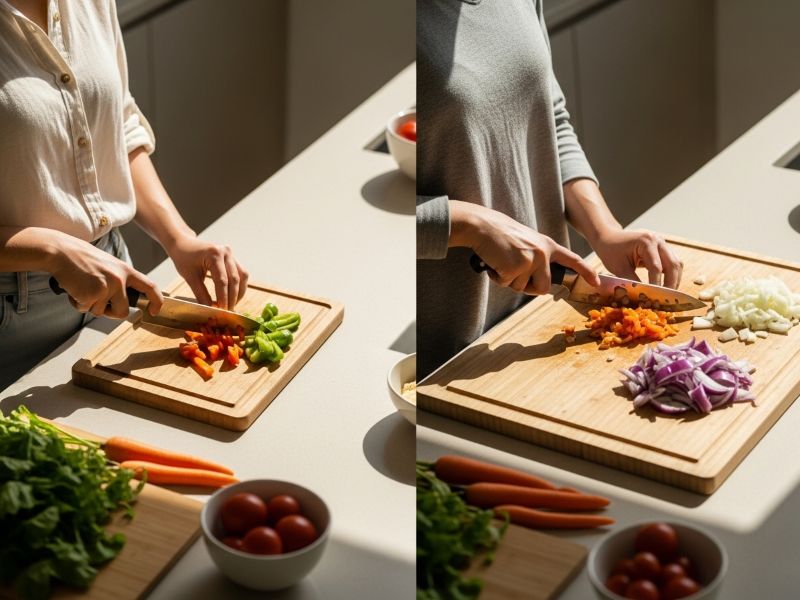
Find where you do most of your cutting – usually between the stove and sink. Your board should cover no more than 60–70% of this area to leave room for bowls, utensils, and safe movement.
Step 2: Match size to cooking habits
Track your typical meal prep. For daily cooking (2–4 people, light chopping), a 12″ × 18″ board works well. Larger families or frequent bakers and meat preppers benefit from 18″ × 24″.
Test your setup: if ingredients crowd or overlap, you need a bigger board; if much of it stays unused, you can downsize.
Step 3: Consider storage and weight
Measure available cabinet or counter space. Boards stored far from your main prep zone tend to get ignored. Vertical racks near your counter work for boards up to 18″ × 24″; larger ones may need permanent placement. Keep in mind – heavier boards (8+ pounds) can be tricky to handle, especially from high shelves.
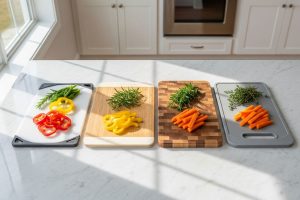
Step 4: Plan for multiple board strategy
Many cooks keep 2–3 boards for different needs:
- One small board (10″ × 12″) for quick tasks – cheese, herbs, garnish prep
- One medium board (12″ × 18″) for daily cooking – vegetables, fruit, bread, small protein portions
- One large board (18″ × 24″) stored separately for periodic use – butchering, holiday cooking, large-batch prep
This approach costs more initially but extends the life of each board because use is distributed based on task appropriateness rather than defaulting to one board for everything. The medium board sees daily use and requires replacement every 5-7 years; the large board might last 15 years with proper care because it’s used monthly rather than daily.
Step 5: Test before committing to custom sizes
If standard sizes don’t fit your kitchen, try a similar size for 30 days before committing to a custom one. Note what feels comfortable and practical.
The goal is matching board size to how you actually cook, not how you imagine cooking. Many users overestimate their need for large workspace and underestimate the inconvenience of managing oversized boards. Start conservative; you can always add a larger board later if your cooking patterns genuinely require it.
Read more: End Grain vs Edge Grain vs Face Grain Cutting Boards: Which One Should You Choose?
Material and Size Compatibility
Different materials behave differently at various dimensions – wood grain structure, plastic composite engineering, and manufacturing processes all influence what sizes perform well in each material category.
| Material | Typical Size Range | Pros | Cons |
|---|---|---|---|
| Wood (Maple, Walnut, Cherry) | 10″×12″ to 24″×36″; thickness 1″–2.5″ | Natural antimicrobial properties; self-healing surface; knife-friendly; attractive appearance | Requires regular maintenance (oiling); susceptible to warping if improperly cared for; heavier weight; higher initial cost |
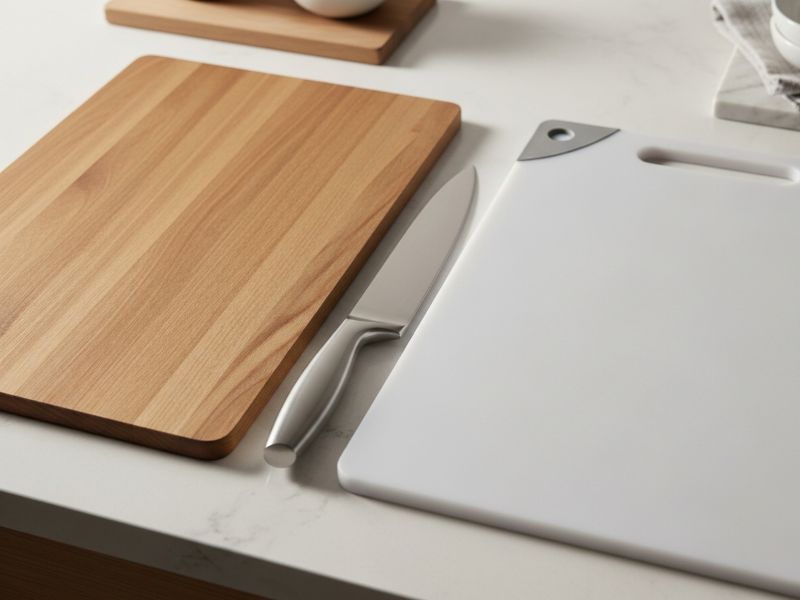
| Plastic Composite (HDPE, Polypropylene) | 8″×10″ to 18″×24″; thickness 0.5″–1″ | Dishwasher safe; low maintenance; affordable; available in color-coding for food safety | Develops deep knife scars over time; no self-healing properties; can dull knives faster; less stable in thin versions |
Wood boards: Grain direction determines performance – edge grain is stable, end grain is self-healing but heavier. Most start at 1 inch thick to prevent warping. Large boards (18″ × 24″+) use edge grain to stay practical, as end grain versions are too heavy and costly.
Plastic boards: Thin plastic (<¾ inch) flexes easily; quality ones stay around 0.75–1 inch. They resist warping unless exposed to heat and work best in 12″ × 18″ sizes. Larger ones lose their weight advantage and become awkward to handle.
The practical guidance: for boards 12″ × 18″ and smaller, material choice is preference-driven (maintenance tolerance, aesthetic concerns, budget). For boards 18″ × 24″ and larger, wood becomes the logical default because it’s the only material engineered to perform well at those dimensions without excessive weight or cost.
Conclusion: From Standard to Signature
Standard cutting board dimensions exist because they’ve been tested across millions of kitchens and proven to work for specific task categories. The 12″ × 18″ medium board dominates home kitchens because it solves the workspace-storage-weight equation for typical cooking patterns. Smaller and larger sizes serve real needs – quick prep and professional-scale cooking respectively – not marketing segmentation.
Thickness matters more than most users recognize. Boards under 1 inch warp within two years regardless of material; boards at 1.5 inches last a decade with basic care. The cost difference is $20-40, but the longevity difference is 5-8 years – a clear value proposition when you account for replacement cycles.
Your signature size emerges from honest assessment of how you cook, where you store tools, and what trade-offs (weight, maintenance, cost) align with your priorities. Standard dimensions provide the starting point; your kitchen habits and physical space determine which standard works. The goal is finding the board you’ll actually use consistently, maintained properly, for years – that outcome depends on matching dimensions to reality, not aspiration.